Thursday, 19 December 2013
Monday, 9 December 2013
MY WRITING PROCESS #mywritingprocess
Today is Blog Tour day, when writers answer
questions about their writing process. Last week, fellow author Penny Grubb
posted hers. You can check it out at http://pennygrubb.blogspot.com.
Penny is a hard act to follow, but I thank
her for the invitation.
So, what is my writing process? I always
have a notebook and pencil but the main area for work is my study. I would blush
to let anyone see inside but all those books, papers and maps are lying around
for a purpose. The cat enjoys prowling among them to find a cosy nook to sleep,
until he senses I'm totally absorbed. I draw a veil over the language used when
he pulls me out of my other world.
1 What
are you working on?
I'm writing the second story about brothers
in a half-French, half-Turkish family. The period is 1811 - 1813, so the
background is the Napoleonic wars and the general turmoil throughout Europe . My main character is a Rake but he longs for a
proper role to equal his older brother, the skilled diplomat [whose story is
told in Scandalous
Lady]. I'm sure his brother would have
cautioned him: Be careful what you wish for! In his eagerness to undertake a
noble quest, he becomes entangled with a pair of vicious spies and faces one
crisis after another in a fast paced chase across England
and France .
2 How
does your work differ from others of its genre?
I'm a great fan of all Regency stories but
I particularly like tales set in exotic places. There were plenty of
independent women who set off to discover the world, so I combine those two
elements. I've written two tales set in Constantinople [which was on the
tourist trail for rich aristocrats with a yacht ] and my current novel begins
in the Pyrenees, from where the hero travels to meet with the French royal
family who were in exile in England
in 1813.
3 Why
do you write what you do?
My family were great storytellers and I
always had enough imagination to add further episodes to the tales we told each
evening around the fire. And if I read a story I particularly liked, I couldn't
part with the characters, so I made up further episodes for them. Long ago and
far away were my favourite places. So I'm simply carrying on the family
tradition. Also I love accounts of intrepid women adventurers, and model my
heroines on them. Currently, I feel very at home in the wider Regency era, although I also love - and write - medieval adventure stories.
4 How
does your writing process work?
A story always begins from a picture or two.
I have an ever-growing collection of faces and places, found in
magazines. Suddenly one face stands out and his or her story begins to take
shape. Some scenes are clear immediately although I don't know at that point
where they will be in the novel.
I scribble a working synopsis, about half a
page. This grows and changes as I go along. By Chapter 3 the characters are
dictating what they will and won't do. It's a weird process but it truly
happens. Of course, there is plenty of research, which may lead to some
revision.
For In All Honour I walked the streets of Bath to be sure the timing of the characters'
outings is right.
For my current story, [gulp] I ventured a kilometre
inside a vast prehistoric cavern in the Pyrenees ,
then transferred my fear of this adventure to my heroine. Most recently, I made a
visit to Hartwell House in Buckinghamshire, which was absolutely wonderful and inspired extra
elements for the plot.
Editing and revision take place as I write.
If something feels wrong, it disturbs my sleep. That means that the following
morning I grab paper and pen before even getting out of bed to rewrite the scene or move events to a better
place. Normally, I prefer to write in the late evening, until the inspiration
gives out.
Thank you for visiting my blog. Please leave a
comment.
NEXT WEEK
Jane Riddell, editor and writer of short
stories and novels. The photos of her travels on her website are wonderful. http://www.quietfiction.com
Elizabeth Hanbury writes historical
romance with swoonworthy heroes, sparkling heroines and a dash of wit and
humour. http://elizabethhanbury.blogspot.com
Paula Martin, romance writer and
contemporary romance author. Http://paulamartinpotpourri.blogspot.co.uk
Tuesday, 3 December 2013
Interview with Jane Riddell
My guest today is Jane Riddell
Jane is an Edinburgh-based writer, editor and
photographer. Her work includes short stories, life writing and contemporary
novels, which she qualifies as "quiet fiction". In addition to
writing and blogging, Jane runs an editing agency, Choice Words Editing.
Her
recently published debut novel is Daughters of the Lake, a contemporary drama about a family reunion which doesn’t go as
planned.
Madalena invites her four adult children to Switzerland to help her celebrate her hotel’s 40th anniversary, not knowing that there are secrets and tensions amongst them. What is meant to be a happy occasion turns out to be a stormy one.
1- Jane, could you define quiet fiction?
I’d
never heard of ‘quiet fiction’ until a
tutor suggested my writing fitted this description. If you ‘google’ the term, you don’t really
find anything. Realistic fiction, on the
other hand, is more widely-used and is defined as a story about real people
experiencing situations that could really happen. I have concluded that the two terms have
similar meanings.
2 - Why did you choose overseas
locations for your novels?
I
love to travel, and choosing other countries as a setting allows me to spend an
afternoon in the mountains and lakes of Switzerland, or the beach and hillside
villages of southern France, when those around me are enduring yet another wet,
blustery Edinburgh afternoon. The
location for Daughters of the Lake, I think, was
inspired by Anita Brookner’s Hotel du
Lac. After finishing another novel,
I decided that lakes and mountains would be my next setting. Shortly after I spent several days in Brunnen,
on Lake Luzern in Switzerland, and -
more slowly than I would have expected -
realised this was the idea setting for Daughters of the Lake. I began writing the novel immediately.
3 - When and why did you start
writing seriously?
I had been writing as a
hobby for many years, but was never caught up enough in it to work on something
for more than a couple of hours at a time. During most of these years I had
a paid job. When we decided to move to France, things
changed. I was unlikely to be able to work there because of my limited
French, and reckoned that I would probably spend more time writing.
Several months before we left Edinburgh, during a Saturday afternoon at the
gym, I found myself on the treadmill, listening to Martha Reeves and the
Vandellas singing Dancing in the Street, and thinking: I’ll have a
go at becoming a serious writer. Perhaps I
was inspired by the music that afternoon, perhaps the desire to make writing
more important simply crept up on me.
Maybe I felt that the newness of another country would make my writing
more pivotal to my existence.
When we arrived in
France, I discovered I could write for longer chunks of time, and became quite
productive in terms of finishing pieces of work, rewriting short stories and
starting work on a new novel.
4
- What do
you think are the basic ingredients of a story?
A believable
plot, realistic characters, a well-described setting and good dialogue. For me, too, how the story is told greatly
affects my pleasure in it: not too much explanation, the right balance of action,
reflection and dialogue, leaving the reader space to draw their own
conclusions.
5
- What are your writing strengths and
weaknesses?
Feedback
suggests I have the ability to describe a setting in a way that pulls readers
in. I have never thought I could do
that, not compared to other authors, for example, Anita Shreve, whose
descriptions of severe winters on the east coast of the US are wonderful. I think dialogue is one of my strengths. I’ve read copious technical books about
writing and always been particularly interested in sections about
dialogue. When I did my Masters in
Creative Writing, I learned about the use of subtext as a way of adding
richness and tension to conversations.
Although I haven’t quite got to grips with this technique yet, I do try
to deploy it in my writing.
As
for weaknesses - I don’t have particularly good imagination, and I find endings
difficult. It’s so tempting to tie
everything up neatly but that’s just too convenient and not realistic. I also have to work hard at not rushing
through a scene, giving the reader time to absorb it, and not to include too
much banal domestic detail. I’m sure
there other areas worthy of improvement, but these are the ones that
immediately spring to mind.
6
- What elements do you consider essential
for a character to be believable?
Not
too perfect, not too villainous. I think
there has to be consistency of behaviour, or at least a consistent
inconsistency, if this makes sense.
It’s important, too, to convey or at least hint at depth of personality.
7 - Do you have a routine for your
writing?
Definitely
not. Since living in France I’ve adapted
to a mid-Atlantic time zone with afternoon mornings, and evening
afternoons. Not a good idea, on balance,
but with no pressure to do so, it’s hard to change. I tend to do some writing or promoting my
work every day, but there’s little rhyme or reason to what and when this might
be. Fortunately, I have no desire to be
the kind of writer who knocks out a book every year and as I rarely have
deadlines imposed on me – sometimes with editing work I am given a date - I
don’t completely buy the ‘routine’ bit.
That said, I met a delightful person this week, who works full time and
has already completed seven books this year, and if I’m being honest, I realise
that if I did have a routine, I would probably be more productive.
8
- How long does it take you to complete a
novel?
It
varies. Daughters of the Lake took just under four years, but it underwent various
drafts. I first submitted it to agents less
than a year after starting it, believing it was ready and, understandably, got
nowhere. Then when we returned from
France to the UK and I started studying for my Masters, at the lecturer’s
advice, I reluctantly put it aside until I’d finished the course. When I picked it up again, I realised it
required substantial revising, and this took two and half years. My current novel, Chergui’s Child, has been on the go, off and on, for 12 years!
9 - If you could go to any part of
the world to write a novel, where would you choose to go?
Nepal,
perhaps, or Kashmir. I spent a week in
Nepal and it was magical. As for the
purply grey light of Srinagar - I will never forget that. I think either of these places would be
inspirational, or perhaps a tea plantation in Darjeeling.
10
- What type of reading inspires you to write?
Probably the
same sort of thing that I write – quiet fiction. Authors such as Anita Shreve, Anita
Brookner, and Ian McEwan have influenced me – for their beautiful use of
language, the depths of their characterisation, and their ability to describe
locations. I am not so interested in
genre writing, although as I currently watch a lot of police procedurals on
telly, it’s occurred to me I might enjoy reading them, and perhaps one day,
trying to write one….
11 - What are
you working on now?
I’m
rewriting Chergui’s Child. Like Daughters of the Lake, CC did the round of agents while we were living in France, and didn’t
get very far. As I still strongly
believed in its storyline, I returned to it just over a year ago. The structure of the telling has changed
significantly, and I’ve been editing it for a while now.
12 - What do you do when the going gets tough?
I’ve experienced two episodes of writer’s block so far. The first was after I finished my
Masters. It was a difficult year
academically and there was some unpleasantness. I emerged from it bloody - if unbowed - and a bit stuck. This period coincided with an elderly
relative having a massive stroke. I
think the combination of the Masters’ experience and the distress of my aunt’s
condition resulted in a stuckness. I
would look at Daughters of the Lake and
think: so what? Who cares?
What I did was spend the next five or six months blogging hard to keep
my writing muscle exercised, and made notes about how to write from various
‘how to’ books. At this time I’d begun working
with a mentor, who was gently encouraging and gave me constructive feedback
about my writing. Gradually the energy
returned, and the rest, as the saying goes, is history.
I’m stuck
again, this time with Chergui’s Child. This might partly be due to having received
some positive reviews of Daughters of the Lake and an anxiety about CC not living up to possible readers’ expectations. Or it might be because there’s a fundamental
problem I have to sort out with CC. At
the moment, therefore, I’m spending more time promoting WE - directly and indirectly - than writing
CC.
13 - Your photos are very evocative. Do you
use them to inspire your writing?
I think I do,
but indirectly. I take loads of photos
when abroad and the fact that I’m so keen to display them on my author’s
website, suggests that there’s a connection – certainly with my identity. I don’t kid myself that I’m anything like a
professional in my technique, but my tendency to view scenery through the eyes
of a lens, is strong. I think my photos
are often in my head, i.e. I can think about them when I’m not actually viewing
them. And so they inspire me. Certainly when living in France and
surrounded by the most beautiful mountains and national parks, I wrote
prolifically.
14 - How does your editing work affect your
writing?
I find that
mixing my own creative writing with other people’s writing, whether it’s
fiction or non-fiction, works well. The
commonalities of both are the need for precision, logical flow and eliminating
unnecessary words. When I’m struggling
to connect with my own creativity, it’s a pleasure, and a relief, to be working
on someone else’ s writing and not to have to be imaginative. But when I’ve been doing this for a while, it
feels positive to return to my writing.
The more I
edit, the more I see the need for further editing of my own work. If I were to look back at Daughters of the Lake now, about 18 months after
finishing it, I’m sure I’d find scope for further revision.
Jane Riddell's website http://www.quietfiction.com/
and her Blog Papillon:Inconsequential thoughts
http://www.blogger.com-janelilly.blogspot.co.uk/
Jane Riddell's website http://www.quietfiction.com/
and her Blog Papillon:Inconsequential thoughts
http://www.blogger.com-janelilly.blogspot.co.uk/
Monday, 21 October 2013
Cymru - The Land of the Red Dragon
At last we reach Rhayader, a market town on the River Wye. The Clock Tower at the crossroads marks the important routes to all parts of Wales. Rhayader was a 19th century staging post on the coach road from Aberystwyth to London. Earlier than that, cattle drovers driving their flocks of sheep to markets in Hereford or even as far as London, would halt in Rhayader to rest and get provisions.

More recently, the town has become a stopping place for tourists who want to visit the Elan Valley, with the impressive Victorian built dams that provide water for the city of Birmingham. After a day spent wandering around this wild and beautiful area, it's easy to see how stories of monsters, heroes and magic developed in the land.
[The following five pictures of the Elan Valley and its dams are by courtesy of Mackenzies of Rhayader and are all (c)Mackenzies ]
[You can enlarge the pictures by clicking on them ]
[above] Craig Coch reservoir
[above] Pen y Carreg reservoir
This region was once the kingdom of Vortigern...but that's another story and deserves a post of its own.
Sunday, 25 August 2013
Rose Petal Jam
Today I'm delighted to welcome my Turkish friend, Seyda as my guest. She's an incredibly busy lady but she's sparing the time to explain how to make Rose Petal jam. Having tasted this delicacy in her home, I know it's as delicious to taste as it's beautiful to look at. And actually, it isn't too difficult to make.
Welcome, Seyda, and thank you for dropping by.
Not at all, it's my pleasure. It's always nice to chat. And of course, I'm happy to explain how to make Gül Reçel.
I was fascinated by the beautiful pink colour of your jam, and the fact that it was absolutely clear. How do you achieve that?
You can only make this jam with pink, scented roses, and they have to be cabbage roses or centifolias. You pick the petals from six fully opened roses, all on the same day.
Remove any bits of stamen, then wash the petals in a large bowl of water until clean. Drain well and shake in a sieve.
Mix together 5 tablespoonfuls of caster sugar
The juice of half a lemon
1 crystal of lemon salts [the size of a pea]
The rose petals
and squeeze it all into a paste, which you put into a sealed jar.
Store this paste in the fridge [it will keep for months]
And how does this become jam?
When you are ready to
make the jam, you start by boiling together 3 1/2 glasses of water and 3 glasses of sugar.
Boil until it is a
thick syrup. Test by dropping a little on a saucer. When it does not run it is
ready.
Add the rose mixture
from the jar. Stir for five minutes while the mixture is boiling. When it foams
and hisses, it is ready. Turn off the heat.
Allow to cool for a
few minutes, then put into glass jars [pretty ones if you have them]. Seal when
cool.
And finally, what do you use it for?
We may use it on a sponge cake, or put a spoonful on top of a portion of rice pudding or a tablecream. It can also be eaten at breakfast or at tea time.
As we say in Turkish: "Afiyet olsun" - enjoy and may it do you good.
Before you go, let's enjoy a cup of Turkish
coffee - and perhaps you'll read my fortune.
Sunday, 11 August 2013
A home for my hero
The Princes' Islands are situated at about an hour's sailing time from the European side of Istanbul. They are a peaceful haven, where wealthy Istanbullus have a summer villa, or if not rich enough to own or rent one, go for a few days holiday in a hotel. The journey by boat sets the mood - no racing along the motorway, it is a restful interlude.
The islands have been inhabited for as long as Constantinople itself, so it seemed feasible to give my hero a home on Buyukada, the largest island. Research to decide where and what style of house, was indeed a pleasure for me. The villas are delightful but traditionally they are made of wood and so are not generally very long lasting.
There are only a couple left old enough to represent a building typical of the 18th Century. Judging by this engraving, the older villas were large and elaborate - very suitable for my hero's mother, who is a Turkish princess.
Fortunately for Olivia in Scandalous Lady, the hero's yali is always kept in good order for when members of the family visit from France. Selim sends Olivia here as a place of safety. In his mother's house, she is protected by the laws of hospitality from the Sultan's plan to dispose of her.
When you disembark, the peaceful atmosphere continues. There are no motorised vehicles on the island. Transport is either by bike or by horse drawn carriage. The roads are really quiet.
The villas are mainly set back in beautifully tended gardens.
The islands have been inhabited for as long as Constantinople itself, so it seemed feasible to give my hero a home on Buyukada, the largest island. Research to decide where and what style of house, was indeed a pleasure for me. The villas are delightful but traditionally they are made of wood and so are not generally very long lasting.
There are only a couple left old enough to represent a building typical of the 18th Century. Judging by this engraving, the older villas were large and elaborate - very suitable for my hero's mother, who is a Turkish princess.
Fortunately for Olivia in Scandalous Lady, the hero's yali is always kept in good order for when members of the family visit from France. Selim sends Olivia here as a place of safety. In his mother's house, she is protected by the laws of hospitality from the Sultan's plan to dispose of her.
Labels:
'Scandalous Lady',
Buyukada,
The Princes' Islands
Thursday, 20 June 2013
Sunshine and warm hearts
After the winter that wouldn't end, I was in a hurry to get back to Turkey to be cheered up by kind relatives and friends as well as by large doses of sunshine and warm hospitality. Nothing is too much trouble when they have a visitor, even in such uncertain times as they are living now and they are weighed down by the apprehension of what could happen.
Meals are always an opportunity to crowd everyone round a table groaning with goodies. I love the differences between a Turkish breakfast and our own.
Here we have a selection of salads and savoury patties, made with bulgur wheat and red lentils.There are lemons to squeeze over the salads and fresh mint for extra taste. Then there are poacha, boat shaped pastries filled with white cheese and herbs, various small buns and a ring cake full of chopped almonds and walnuts.
As at breakfast, the preferred drink is tea.
Later, there will be a huge plate of fruit, nicely chilled in the fridge and very welcome in the torrid heat and finally Turkish coffee, followed by fortune telling for those who want it.
Meals are always an opportunity to crowd everyone round a table groaning with goodies. I love the differences between a Turkish breakfast and our own.
The central tray contains different white cheeses, made from goats', cows' or sheeps' milk and the firmer, yellow kashar cheese. Then there is butter, kaymak [cream from the top of yogurt], green and black olives, dried apricots and their kernels, walnuts, honey and rose-hip jam. Oh, and fresh chopped tomatoes, peppers and cucumber. All washed down with copious amounts of black tea.
And then there are the invitations to afternoon tea, which is more what we would consider a high tea.
Here we have a selection of salads and savoury patties, made with bulgur wheat and red lentils.There are lemons to squeeze over the salads and fresh mint for extra taste. Then there are poacha, boat shaped pastries filled with white cheese and herbs, various small buns and a ring cake full of chopped almonds and walnuts.
As at breakfast, the preferred drink is tea.
Later, there will be a huge plate of fruit, nicely chilled in the fridge and very welcome in the torrid heat and finally Turkish coffee, followed by fortune telling for those who want it.
Saturday, 27 April 2013
A Taste of Eastern Splendour
APRIL AND MAY
Caught in a compromising
situation with Tom, Rose is whisked away in disgrace and hastily married off.
Four years later, widowed but still heartsore that Tom abandoned her without a
struggle, she is horrified to encounter him again - and in Constantinople
of all places. Worse, she has to work with him on a secret document for the
Sultan. Kerim Pasha, the powerful and
handsome minister, is entranced by Rose's English beauty and immediately spirits
her off into his home.
Tom has never forgotten
Rose but even now, the misunderstandings continue. In addition, Rose is
determined to maintain her hard-won independence. But back in London , she soon finds that not only Tom, but
Kerim Pasha also, has arrived and
neither has given up hope of winning her.
Published by Robert Hale ISBN 9780709090427
www.amazon.co.uk
www.halebooks.com
READ AN EXCERPT
This is from Chapter 2, when Tom and Rose come face to face so unexpectedly, after a long gap, in Constantinople.
Tom gulped and frowned at the empty glass.
Just what had Mehmet put in the hoshaf? To his annoyance, a large blot was
spreading over his sketch. With a sigh he set his pen down and looked up again
reluctantly. Apparently it was not an illusion. The three dark shapes were
still there.
Not for the
first time he found himself wishing that he knew just what he was looking at.
Some ladies wore only the lightest of silken veils and you could more or less
look them in the eye. These three were completely hidden. He scowled. How dare
they invade his office at such a time.
Behind
them he spotted Sebastian Welland, making frantic gestures to him to stand.
With a sigh, Tom rose to his full six foot three. There was a rustle as three
heads shifted upwards beneath their wraps. From behind one of the veils came a
sudden sharp intake of breath. Then silence. Tom’s thick brows drew down as he
glared from one to the other, waiting. Normally women did not appear in public
offices, especially Turkish women. Was it some kind of plot to disrupt these
delicate negotiations?
Sebastian
now reappeared, together with Mehmet, carrying chairs. As he placed the seats
for the visitors the young man stammered: ‘Ladies, this is our special envoy,
Mr Hawkesleigh.’ Turning to Tom he quailed at the glare he received but
persevered in his explanation. ‘I know you said you were not to be disturbed…
but…but the Ambassador’s guest is still here…’
Tom
glared again at his unwelcome visitors. ‘I regret I cannot spare any time at
present -’
At this, the
smallest one put back her veil with an impatient gesture. Tom saw that she was
fair skinned and haired. She looked to be in her late forties and had a keen,
scholarly air.
‘Lady
Emily Westacote,’ she said briskly, ‘and these are my two nieces.’
‘Westacote?’
echoed Tom. ‘Sir Philip Westacote, the antiquarian…?’
Lady
Westacote nodded. ‘Just so. I am his wife. And we are in need of help.’
‘In
what way ma’am?’ Tom knew his tone was less than cordial. She probably wanted permits
to excavate some godforsaken ruin in a remote and bandit-infested area of the Levant . Surely it could wait half an hour. His frustrated
gaze turned to the other two females. They had not removed their veils.
Lady
Westacote followed his gaze. ‘Girls!’ she said reprovingly. At this the figure
on her left raised her arms and put back the heavy veil to reveal a lovely face
with huge pansy brown eyes and shining dark hair. Tom’s eyebrows lifted a
little and Sebastian gaped in frank admiration. Then their heads all turned
expectantly towards the last veiled figure. There was a pause then very slowly
she raised her arms. Tom could sense the reluctance with which she folded back
her veil. Then he drew in his breath sharply. His brows met across his
formidable nose in a deep frown.
The
young lady met Tom’s eyes. Her oval face was pale and mask-like. Her hair was
the colour of ripe wheat, just as he remembered. Tom felt a kind of pressure on
his heart. Of all the impossible coincidences. What could bring Rose Graham
here?
‘Allow
me to present Mrs Rosalind Charteris,’ Lady Westacote indicated the fair haired
girl, ‘and her sister, Miss Helena Graham.’
Charteris!
So she was married now. Tom could feel the blood draining from his cheeks. He
kept his face impassive as he sketched a bow in the general direction of the
young ladies. The surge of emotion and anger swamped him. For a moment he could
not speak. Then he recovered enough to snap his fingers at Sebastian, who was
still gazing from one beauty to the other. The young man gulped, nodded and
disappeared, to return a few minutes later with Mehmet and the tray of glasses
and fruit juice.
While Mehmet poured drinks for the ladies,
Tom stole a look at Rose Charteris. She was every bit as lovely as his memory
of her. That glorious hair, so silky and thick, her creamy skin and that
provocative pink mouth. He clenched his jaw against the memory of their last
meeting. In spite of the years abroad, he had not forgotten the feel of her in
his arms. He instinctively knew how ill at ease she was. She had not expected
to find him here. She was gazing round the room, not looking in his direction.
His mouth twisted. So what! She had married another man. And why was he
surprised at that? She had never answered a single one of the many letters he
had sent her.
(C) Beth Elliott
(C) Beth Elliott
www.amazon.co.uk
www.halebooks.com
Tuesday, 16 April 2013
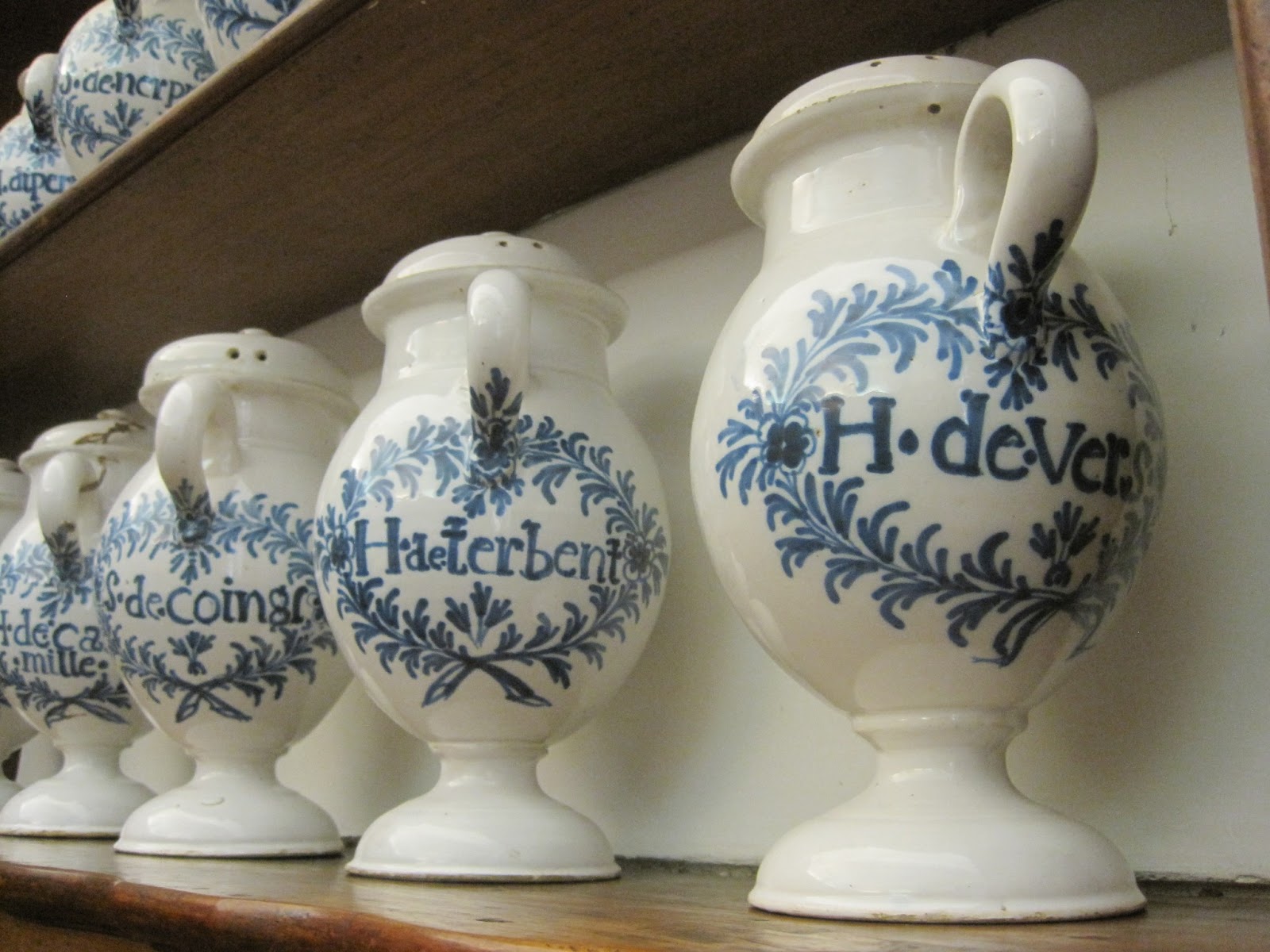
An 18th Century Pharmacy in Saint-Lizier, Ariège-Pyrenées
The town of Saint-Lizier in the Pyrenees dates from the 5th Century and has a rich variety of historical monuments of many periods. It is on the pilgrim route to Compostela and its cathedral is dedicated to St James.
As well as the straight shelves on all four walls, there are four matching corner cupboards, with glass panelled fronts. All the pots and bowls on the shelves were made specially at a pottery near Toulouse . Every pot has the name of the remedy it contains painted on before the pots were fired, so there was no possibility of mistakes with the contents.
A little more grisly, in one of the corner cupboards there is the set of surgical tools, including knives and saws. There are also two large, marble topped tables for preparing medicines or for operating on sick people. Close by the tables are two enormous marble mortars and pestles for preparing and mixing medicines.
The Vinegar of the Four Thieves
From records kept in the hospital, it has been possible to reconstitute the 'Vinegar of the Four Thieves'. This remedy protected against the plague. During one terrible outbreak of plague in Toulouse in 1630, four thieves were caught stealing from the dead victims. These four did not become ill with plague, and the doctors discovered that the men had concocted a lotion that they spread on themselves, [hands, face, armpits and nether regions] which prevented the fleas from jumping on them. In exchange for the recipe, they escaped execution. The remedy is based on vinegar and many herbs, plus camphor.
For more information on Saint-Lizier, see :
https://www.ariege.com/en/discover-ariege/must-see-places/saint-lizier
Sunday, 17 March 2013
Rome
A four day trip to Rome is enough time to exhaust yourself but woefully inadequate to see much of the Eternal City. However, we managed to fit in at least two churches and two museums each day as well as a splendid exhibition of Titian's paintings, a hike across the Borghese Park and a stroll round the Trastevere district with its quaint little alleys and squares. Of course, anyone walking around Rome comes across piazza after piazza, fountain after fountain - and all decorated with enormous baroque statues. Then there are the mighty columns and the obelisks. I gave up counting those - but it seems an obelisk was the must-have souvenir for any Roman general of the classical period. Add to this the antique ruins and the palaces of many styles and ages and you have a mix that is special to Rome.
And the streets are mostly cobbled....
Perhaps that is why my favourite discovery was the splendid Garden frescoes from the Villa of Livia. They are on display in the Palazzo Massimo alle Terme. In about 30 BC, Livia, wife of Augustus, decorated her dining room with these garden frescoes to give the impression of being outdoors. In the fierce summer heat, they created a feeling of coolness. They are wonderfully fresh and soothing, even today.
Monday, 11 February 2013
Inspirational Valentines, one and all.
I know I'm not the only writer to get inspiration for my characters from film clips or photos of actors. The fictional character has his path set out and his actions planned, but to get him walking off the page, I need inspiration - and where better to find it than in by mixing and adapting the appearance, the voices and mannerisms of such a bunch of gorgeous guys.
Thank you, fellas, for providing the details that really help to bring my heroes and their friends to life. This is a virtual Valentine's Day party for you - and all the others, too numerous to post here. There's plenty of champagne and canapés.
10

***************************************
*In case* anyone doesn't recognise one or other of them....
1 Antonio Banderas 2 Burak Ozcivit 3 Dan Stevens 4 George Clooney
5 Henry Cavill 6 Ildebrando d'Arcangelo 7 Mehmet Gunsur
8 Richard Armitage 9 Santiago Cabrera 10 Colin Salmon
5 Henry Cavill 6 Ildebrando d'Arcangelo 7 Mehmet Gunsur
8 Richard Armitage 9 Santiago Cabrera 10 Colin Salmon
******************************************
Subscribe to:
Comments (Atom)